


Why the World Doesn’t Exist: A Logical Audit of East, West, and Science

Updated: Feb 11
Most of us spend our lives trying to understand the "What" and the "How" of the world: What is matter? How did the universe begin? We look to physics, religion, and philosophy for a "Blueprint" of reality.
This blog post performs a Causal Audit. We move through the history of human thought—from the ancient materialists of India and Greece to modern Simulation Theory—to see how each system explains the origin of the world.
The Discovery: As we climb the "Causal Ladder," we find that most systems eventually break under the weight of their own logic.
Realism fails to explain where the first "thing" came from.
Theism fails to bridge the gap between a perfect Creator and an imperfect creation.
Science fails to explain the very observer (Consciousness) that makes science possible.
The Advaitic Apex: We eventually arrive at the "Non-Dualism" of Gaudapada and Shankara. Logically, it is the most robust system ever devised because it is the only one that doesn't rely on assumptions. It is the "Final Audit" that concludes: The world is an appearance, not a separate creation.
The Great Tension: However, being "logically correct" does not make a philosophy "easy to live." We conclude by critiquing Advaita’s greatest weakness: The User Experience. We explore why it is so difficult to reconcile the "Absolute Truth" (that you are the changeless Screen) with the "Daily Reality" (the tragedy and comedy of the Movie).
Ultimately, we find that Advaita isn't a theory to be "believed"—it is a psychological tool to be used. It offers a path to radical resilience and universal compassion, allowing us to navigate the dream of life with a sense of profound, unshakable peace.
Part I: The Indian Schools (Darshanas)
Charvaka (Materialism/Naturalism)
History: Dated approx. 600 BCE; attributed to the semi-mythical Sage Brihaspati. It is the only "Atheistic" school that rejects all inference in favor of direct perception.
The Theory: Deha-vada (Body-ism). Consciousness is an emergent property of matter. When the four elements (Earth, Water, Fire, Air) combine in a specific ratio, "mind" arises.
Analogy: The Fermentation Analogy: Just as the intoxicating power of wine is not found in the water, grapes, or yeast individually but arises when they are mixed, consciousness arises from the body.
Critical Analysis: It fails to explain the Subject. If consciousness is a "result" of matter, it is an object. Who is the "I" that observes the result? Furthermore, if we only trust direct perception, we cannot even prove the existence of "matter" itself, as matter is only known via the consciousness it claims to produce. Charvaka claims that matter is the cause and consciousness is the effect. But this is logically backwards. It’s like a person looking at a painting of a sun and claiming that the painted sun is what provides the light to see the canvas. In reality, you need the light (Consciousness) first to see the painting (Matter). Matter is a 'conclusion' we reach inside our consciousness; therefore, matter cannot be the 'source' of the very thing that is required to perceive it.
Samkhya (Dualism/Transformation)
History: Attributed to Sage Kapila, approx. 500 BCE. It is the foundation for Yoga philosophy.
The Theory: Satkāryavāda. The effect pre-exists in the cause. Evolution (Parinamavada) is the unfolding of the "Unmanifest" (Prakriti) into the "Manifest" universe to serve the Spirit (Purusha).
Analogy: The Sesame Oil Analogy: You press sesame seeds to get oil because the oil is already in the seeds. You don’t press sand, because oil isn't there. Evolution is just the "becoming visible" of what was hidden.
Critical Analysis: If the effect is already "there," then "production" is a redundant concept. If the Spirit is eternal and perfect, it should have no need for a world. Samkhya fails because it cannot explain how a non-conscious Nature "knows" how to evolve perfectly for a passive Spirit without a third, unifying principle. If Prakriti is eternal and unchanging, how can it transform into a changing universe? This creates a contradiction: eternity implies immutability, but change implies temporality.
Nyaya-Vaisheshika (Atomism/Realism)
History: Founded by Sage Gautama (Nyaya) and Kanada (Vaisheshika), approx. 200 BCE.
The Theory: Asatkāryavāda. The effect is a brand-new creation (Arambhavada) that did not exist in the cause. Atoms are eternal, but the things they make (like a pot) are totally new entities.
Analogy: The New Cloth Analogy: Before the weaver weaves, the cloth is non-existent. The threads (cause) are one thing; the cloth (effect) is a completely separate, newly born entity.
Critical Analysis: If the effect is "new," it was "non-existent" before birth. Gaudapada argues that "nothing" cannot become "something." If a pot is truly different from clay, why can’t we produce a pot from oil or sand? The specific link between cause and effect proves the effect was already latent.
Buddhism (Dependent Origination)
History: Siddhartha Gautama (5th Century BCE) and Nagarjuna (c. 150–250 CE)
The Theory: Pratītyasamutpāda. Reality is a "Stream" (Santana). Nothing has a self-nature (Svabhava); everything arises based on conditions.
Analogy: The Chariot Analogy: A "chariot" is not the wheels, the axle, or the seat. It is a label we give to a collection of parts. When the parts are separated, the "chariot" vanishes.
Critical Analysis: If everything is a fleeting moment, what connects the "I" of yesterday to the "I" of today? If the "cause" dies to produce the "effect," there is no continuity. A stream requires a stationary bed to be recognized as a stream.
Advaita Vedanta (Non-Dualism)
History: Gaudapada (6th Century CE) and Shankara (8th Century CE).
The Theory: Ajativada (Non Origination) and Vivartavada (Apparent Transformation). Brahman is the only reality. The world is an appearance (Mithya).
Analogy: The Rope and the Snake: The "snake" is real while you see it, but it doesn't have its own "power." It is just the "rope" misperceived.
Critical Analysis: It is the only school that solves the "Change Paradox." If the Absolute changes, it isn't Absolute. If it doesn't change, the world can't exist. Advaita solves this by saying the world "appears" without Brahman "changing."

Image Credit: Above
Part II: The Greek Schools
Parmenides (The Way of Truth)
History: Approx. 515 BCE.
The Theory: "Being" is one and changeless. Motion and plurality are illusions. Whatever "is" cannot "not be."
Analogy: Being is like a perfectly balanced sphere—it is full, complete, and has no "room" for change or non-existence to enter.
Critical Analysis: He proves the Absolute but ignores the Relative. He doesn't provide a theory like Maya to explain why we see the illusion. Shankara and Gaudapada introduce the concept of Maya. They don't just say the world is a lie; they say it has a Relative Reality (Vyavaharika). It is "indescribable" (Anirvachaniya)—it’s not totally non-existent (like a square circle), but it’s not absolutely real (like Brahman). This allows the Advaitin to live in the world while knowing it's an appearance. Parmenides leaves you stuck in a binary: Truth or Lie.
Indian Counterpart: Gaudapada (Ajativada) / Shankara (Vivartavada)
The Atomists (Democritus/Epicurus)
History: Approx. 460 BCE.
The Theory: The world is composed of "Atoms and the Void." Everything happens by mechanical necessity as atoms collide in empty space.
Analogy: Just as a few letters of the alphabet can be rearranged to form an infinite variety of tragedies or comedies, a few types of atoms rearrange to form the universe.
Critical Analysis: Like the Vaisheshikas, they treat "Space" as a real container. They cannot explain how "blind" atoms produce the "vision" of the observer.
Indian Counterpart: Nyaya-Vaisheshika.
Plato (Idealism)
History: Approx. 427 BCE.
The Theory: The world of the senses is a mere shadow. True reality exists in the "World of Forms"—perfect, eternal archetypes.
Analogy: Prisoners chained in a cave see shadows on a wall and think they are real. They must turn around to see the Sun (The Form of the Good).
Critical Analysis: It creates a "Dual World" problem. If the "Form" of a horse is perfect and separate, how does it actually "cause" a physical horse to exist?
Indian Counterpart: Sankhya/Yoga (Forms = Purusha, Shadows = Prakriti).
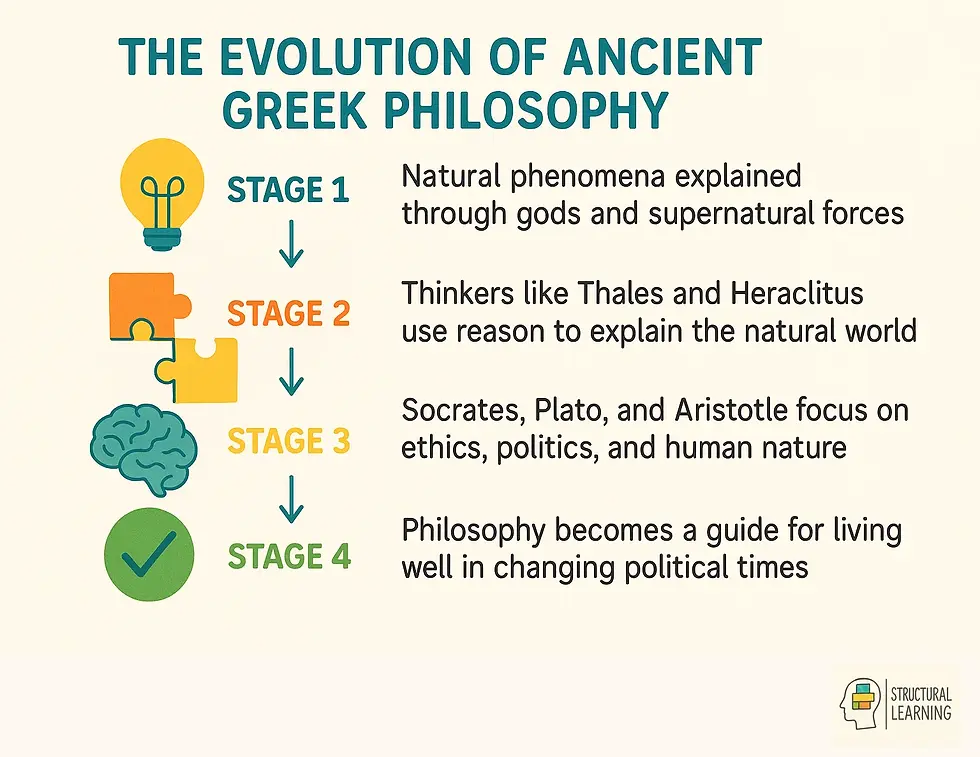
Image Credit: Structural Learning
Part III: Modern & Contemporary Models
Subjective Idealism (Berkeley)
History: 18th Century CE.
The Theory: Esse est percipi (To be is to be perceived). Matter is a mental construct.
Analogy: The Unobserved Tree: Does a tree falling in the forest make a sound if no one is there? Berkeley says the tree exists because God is always perceiving it.
Critical Analysis: This is "Theistic Simulation." It requires a "Broadcaster-God." It fails to realize that the "God" who perceives is the same "Self" that is the reader.
Indian Counterpart: Yogachara Buddhism.
Analytical Idealism (Kastrup)
History: 21st Century CE.
The Theory: Reality is "Mind at Large." We are "dissociated alters" (like personalities in a mind with Dissociative Disorder).
Analogy: The Whirlpool in the Stream: The whirlpool (Individual) looks like a separate thing, but it is just the stream (Universal Mind) moving in a specific way.
Critical Analysis: It treats Brahman as "Mind," which implies mental activity and movement. Gaudapada would argue that Mind is an effect, not the ultimate cause.
Indian Counterpart: Pratibimba-vada of Advaita.
Simulation Theory
History: Late 20th Century (Nick Bostrom).
The Theory: We are code on a computer. "Base Reality" is elsewhere.
Analogy: The Video Game Analogy: A character in The Sims thinks their world is solid, but it’s just 0s and 1s on a server.
Critical Analysis: This is just "Materialism 2.0." It assumes the "Server" is real. It kicks the causal can down the road.
Advaitic Critique: The "Server" is your own Awareness. You are the Programmer, the Code, and the Player.
A Comparison of Reality Models
Philosophy | Category | Theory of Origin | The "Core Logos" | The Logical "Breaking Point" |
Charvaka | Indian Materialism | Deha-vāda | Matter creates Mind (Fermentation). | Cannot explain the "I" who observes the matter. |
Nyaya | Indian Realism | Asatkāryavāda | The Effect is a brand-new creation. | Logic: "Nothing" cannot produce "Something." |
Samkhya | Indian Dualism | Satkāryavāda | Nature transforms for the Spirit. | Cannot explain how dead Matter "knows" to evolve. |
Buddhism | Indian Process | Pratītyasamutpāda | Dependent Origination (The Stream). | Without a permanent Self, memory/karma has no "bed." |
Advaita | Indian Non-Dualism | Vivarta / Ajativada | The many is an apparent appearance. | None. (It accepts the world is logically inexplicable). |
Atomists | Greek Materialism | Atomism | Colliding particles in a Void. | Fails to explain the Subjective "feeling" of life. |
Parmenides | Greek Non-Dualism | Being is One | Change is a total sensory illusion. | Fails to explain why the illusion appears (No Maya). |
Plato | Greek Idealism | Theory of Forms | The world is a shadow of perfect Ideas. | "Dual-World" gap: How do Forms touch Matter? |
Berkeley | Western Idealism | Subjective Idealism | To be is to be perceived (by God). | Requires a "Broadcaster-God" to maintain reality. |
Kastrup | Analytical Idealism | Transpersonal Mind | We are dissociated "alters" of one Mind. | Implies the Absolute "changes" via dissociation. |
Simulation | Modern Scientific | Digital Physics | We are code on a higher-dimensional server. | Infinite Regress: Who simulated the Simulator? |
Part IV: The Critical Audit of Advaita (Vivarta & Ajati)
To keep this "meaty" and balanced, we will look at where the logic of Shankara and Gaudapada hits a wall for the human mind.
The "Why" Problem (The Mystery of Maya)
The Theory: Advaita says the world is Anirvachaniya (inexplicable/describable). It appears, but it isn't "real."
If you ask a scientist "Why?", they give you a chain of "Hows" (Gravity, Big Bang, Evolution).
If you ask an Advaitin "Why?", they eventually say, "The question 'Why' assumes time and causality. But time and causality are part of the dream. Asking 'Why did the Absolute become the many?' is like asking 'Why is the square-root of Tuesday blue?' The question itself is a category error."
This is infuriating to the logical mind. It feels like a dodge. But the Advaitin would argue that the "Why" is a hunger that can never be fed, because every "Why" just leads to another "Why." Advaita tries to kill the hunger, not find the food.
The Advaitic Defense: They call Maya Anirvachaniya. This is a fancy way of saying: "We don't know why the illusion exists, we only know it's not the Absolute Truth."
Critical Analysis: This is often seen as a philosophical cop-out. If you ask a scientist why the grass is green, they give you chlorophyll. If you ask an Advaitin why there is a world at all, they say "Maya," which essentially means "I don't know, it's just an appearance."
The Failure: Advaita fails to provide a motive. Why would Pure, Perfect Consciousness bother with a "projection" that involves suffering, cancer, and death?
The "Where" Problem (The Locus of Ignorance)
The Theory: Ignorance (Avidya) causes us to see the world.
Critical Analysis: This creates a logical paradox. Who is ignorant?
It can’t be Brahman, because Brahman is not a 'doer'. Pure Light cannot have darkness in it.
It can’t be the Jiva (the individual), because the Jiva is a result of ignorance. You can’t have the result existing before the cause.
If Brahman is perfect and non-dual, there is no room for a "Viewer" to be ignorant. If I am Brahman, how did I get "tricked" into thinking I’m a person? If I am the Infinite, where did the "Error" come from?
The Failure: Advaita struggles to find a "home" for ignorance. It ends up in a circular argument: Ignorance creates the person, and the person has the ignorance. For the layperson, this feels like a logical "glitch" in the system.
The "Reality" Problem (The Hard Problem of Matter)
The Theory: The world is like a dream.
Critical Analysis: In a dream, I can fly. In "waking reality," if I jump off a building, I die. The consistency, predictability, and shared nature of the waking world make the "dream" analogy feel weak. If we ask, "How did the gold become a ring?" and the answer is, "It never became a ring, it’s just gold," it does not explain my experience of the ring. You’ve just denied my experience.
The Failure: Advaita struggles to explain why we all see the same sun and the same moon if it is all just a "projection." If it’s my dream, why can’t I change the rules? Shankara distinguishes between Pratibhasika (personal dream) and Vyavaharika (collective dream), but for a realist, "collective dream" is just a fancy word for "Reality."
The "Source" Problem (The Uncaused Cause)
The Theory: Brahman is eternal; it never "came about."
Critical Analysis: The human mind is wired for causality. Every "is" must have a "was."
The Failure: By stating that Brahman is "Unborn" (Ajata), Gaudapada essentially shuts down the inquiry. To a modern physicist, saying something is "uncaused" is the end of science. It feels like an axiom you are forced to accept rather than a conclusion you can reach through physical evidence.
Why Advaita is "Hard" to Reconcile with Daily Life
Even if we logically accept that we are the "Screen" and not the "Movie," we still feel the heat of the fire in the movie.
The Biological Imperative: Our nervous systems are evolved to treat the "Snake" as real for survival. Evolution doesn't care about "Non-Dual Truth"; it cares about "Not Getting Bitten." Advaita asks us to go against 4 billion years of biological programming.
The Moral Void: If everything is a dream, does it matter if I am "good" or "bad"? While Advaita insists on ethics as a prerequisite, the "Hardcore" logic of Ajativada (nothing ever happened) can lead to Nihilism or "spiritual bypassing" if not handled carefully.
The Intellectual Loneliness: To accept Advaita is to accept that your parents, your children, and your history are "Mithya" (apparent reflections). Reconciling deep love with the idea that the "other" doesn't exist is a psychological bridge most people aren't willing to cross.
Final Verdict: Is it a Flaw or a Feature?
The "failures" of Advaita are only failures if you expect a philosophy to explain the World.
The Critics say: Advaita fails because it doesn't tell us how to fix the world or where it came from.
Gaudapada would say: Advaita succeeds because it is the only system honest enough to admit that the "World" is a logical contradiction that cannot be explained—it can only be dissolved.
Analogy for the Critique: Advaita is like a math equation that ends in 0=0. It is perfectly true, but it doesn't help you build a bridge or bake a cake. It is a "Solvent," not a "Blueprint."
The Final Audit: Skeptic vs. Sage
The Skeptic: "Let’s be honest. This feels like the ultimate cognitive hack. You can’t explain the Big Bang, you can’t explain why there are trillions of objects, and you can’t explain the mechanism of Maya. Aren't we just brainwashing ourselves into a 'Oneness' narrative to avoid the pain of being a tiny, accidental speck in a cold universe?"
The Sage (Advaitin): "It is only 'brainwashing' if the 'speck' narrative is the original truth. But look at your own audit. Science says you are matter that somehow learned to feel. Some philosophies say you are a ghost in a machine, and religion says you are divine creation. All of these require a leap of faith. Advaita simply asks: Which is more certain—the particles you've never seen with your own eyes, or the Awareness that is reading this sentence?"
The Skeptic: "But you still haven't answered 'Why?' Why did the One become Many? Why do I have to suffer through the 'Movie' if I'm actually the 'Screen'?"
The Sage: "The 'Why' is the last brick of the ego. To ask 'Why' is to assume that Time, Space, and Causality are real and that Brahman is a 'Person' with a motive. Advaita doesn't answer the 'Why'; it shows you that the 'Why' is a circular loop of the mind. When you stop asking 'Why' and start noticing 'What Is,' the struggle ends. We aren't closer to the origin of the universe—we are closer to the origin of the Observer."
Advaita is the ultimate psychological insurance policy. It doesn't solve the mystery of the Big Bang, but it solves the mystery of the 'Suffering Observer'. It might be 'brainwashing,' but it is a wash that cleanses the mind of the divisions that cause us to destroy ourselves and each other."
In reality, we are no closer to the 'Why.' We have just traded a "Why" that causes anxiety for a "Silence" that provides peace. For some, that is a cop-out. For others, it is the only sanity left in a world that refuses to explain itself.

Image Credit: NeevSelfEnquiry - Anurag Jain
Part V: The Paradox of Power vs. Peace
1. Why Advaita Wins the "Logic War"
Advaita makes more sense than scientific or theistic models because it is the only system that doesn't rely on an external assumption.
Science assumes the existence of an objective world (which it cannot prove without using consciousness).
Theism assumes a Creator (whose origin remains a mystery).
Advaita starts with the only thing that is undeniable: Awareness. It follows the logic of the "Unchanging" to its end. If reality must be eternal and changeless, then anything that changes (thoughts, stars, bodies) must be an "appearance" rather than the "Absolute."
The Day-to-Day Friction: "The Thirst in the Mirage"
The reason Advaita is hard to reconcile with reality is that we are biological entities first, and philosophers second.
The Persistence of Appearance: Even after you know a mirage is just light hitting sand, you still "see" the water. Knowledge doesn't make the world vanish; it only changes its status.
The "Weight" of Suffering: It is easy to say "all is Brahman" when life is good. It is a massive psychological struggle to hold that view when you are grieving or in pain. Advaita requires a "split-screen" mind: acting in the world as if it’s real, while knowing it isn't.
Part VI: Practical Advaita — Making Life Meaningful
If Advaita isn't just a "logical escape hatch," how does it actually help you at 8:00 AM on a Monday? It provides three specific tools for a better life:
Radical Fearlessness (The Screen Analogy)
When you realize you are the Screen and not the Movie, your relationship with "bad scenes" changes.
Application: When a crisis hits (job loss, health scare), you can tell yourself: "The movie on the screen is currently a tragedy, but the Screen itself is not burnt by the fire or wet by the tears." This doesn't make you indifferent; it makes you resilient. You act, but you aren't destroyed.
The End of "Othering" (Compassion via Identity)
If the "other" person is a reflection of the same Consciousness, then hurting them is literally hurting yourself.
Application: Conflict usually stems from the belief that "I" am separate from "You." Advaita moves you from "Empathy" (I feel your pain) to Identity (Your pain is happening in the same field as mine). This creates a natural, logical basis for ethics and kindness that doesn't require a "God" to enforce it.
Presence Without Pressure
Most of our unhappiness comes from wanting the "next moment" to be better than this one.
Application: If you know that Brahman is the "Eternal Present," you stop treating the current moment as a stepping stone. Whether you are drinking tea or in a board meeting, you are in the Absolute. This turns mundane life into a "sacred" experience without needing any religious ritual.
Final Thoughts:
I am not upselling you on Advaita. I am showing you that it is the "Final Audit" of human thought. It is the most neutral stance possible because it doesn't ask you to believe in a "Dreamer God" or a "Server-Simulation." It only asks you to look at the nature of your own seeing.
Advaita doesn't give you a better "dream"; it gives you a way to be awake while you dream. It doesn't tell you the world is garbage; it tells you the world is You—shining in countless forms.
In the end, Advaita doesn’t ask us to reject the world. It asks us to see it for what it is — a magnificent, terrifying, beautiful appearance in the screen of consciousness. And once we see that, we are finally free to play in the dream without being trapped by it.
The Causal Glossary: Decoding the Logic of Reality
The Theories of "How Things Begin"
Asatkāryavāda (Nyaya/Vaisheshika): The theory that the effect is not pre-existent in the cause. The "new" world is born from "nothing" (like a pot from clay).
Satkāryavāda (Samkhya): The theory that the effect is pre-existent in the cause. Evolution is simply the unmanifest becoming manifest (like oil already inside a sesame seed).
Pratītyasamutpāda (Buddhism): "Dependent Origination." The belief that nothing has a soul or essence; things exist only as a chain of shifting conditions.
Parināmavāda (Samkhya/Theism): The theory of real transformation. The cause actually turns into the effect (like milk turning into curd).
Vivartavāda (Advaita): The theory of apparent transformation. The cause appears as the effect without changing itself (like a rope appearing as a snake).
Ajātivāda (Hardcore Advaita/Gaudapada): The "Highest Truth" of Non-origination. The doctrine that nothing was ever born, created, or manifested. Only the Absolute IS.
The Nature of Existence (The Three Levels of Reality)
Pratibhasika (Subjective): The level of the dream or the illusion. Real only while it is being experienced (e.g., the snake in the rope).
Vyavaharika (Objective/Relative): The level of our waking world, physics, and commerce. It has "empirical" reality but is ultimately sublated by higher knowledge.
Paramarthika (Absolute): The level of Brahman/Pure Consciousness. The only reality that is never contradicted and never changes.
The Mechanics of the "I"
Pratibimba-vada (Reflection Theory): The idea that the individual (Jiva) is a reflection of Brahman in the "water" of the mind.
Avaccheda-vada (Limitation Theory): The idea that the individual is just the Infinite "limited" by the walls of the body, like space in a jar.
Mithya: That which is "neither real nor non-real." It refers to the world—it appears to exist, but it has no independent reality of its own.


Comments