


Love vs. Attachment: The Gita's Most Misunderstood Teaching — and What Neuroscience Reveals

I want to start with a confession.
When I first sat with this question deeply — when I placed two passages of the Bhagavad Gita side by side and really looked at them — I thought I had found a flaw. Not a philosophical nuance, not a subtle distinction. An actual contradiction. Two verses, from the same teacher, in the same text, appearing to say the exact opposite thing.
And in my experience, when something in an ancient text looks like a contradiction, one of two things is happening. Either the text is wrong. Or you are not yet seeing what the text is actually pointing at.
This time, it was the latter. And what I found when I looked deeper was not just a resolution of a textual puzzle — it was one of the most profound insights into human psychology and neurochemistry I have encountered anywhere. Ancient or modern.
Let me show you exactly what I mean.
As I was mapping Gita's verses onto the neuroscience of human behaviour — something I have been chronicling in this series — I found myself writing the following observation about two distinct passages:
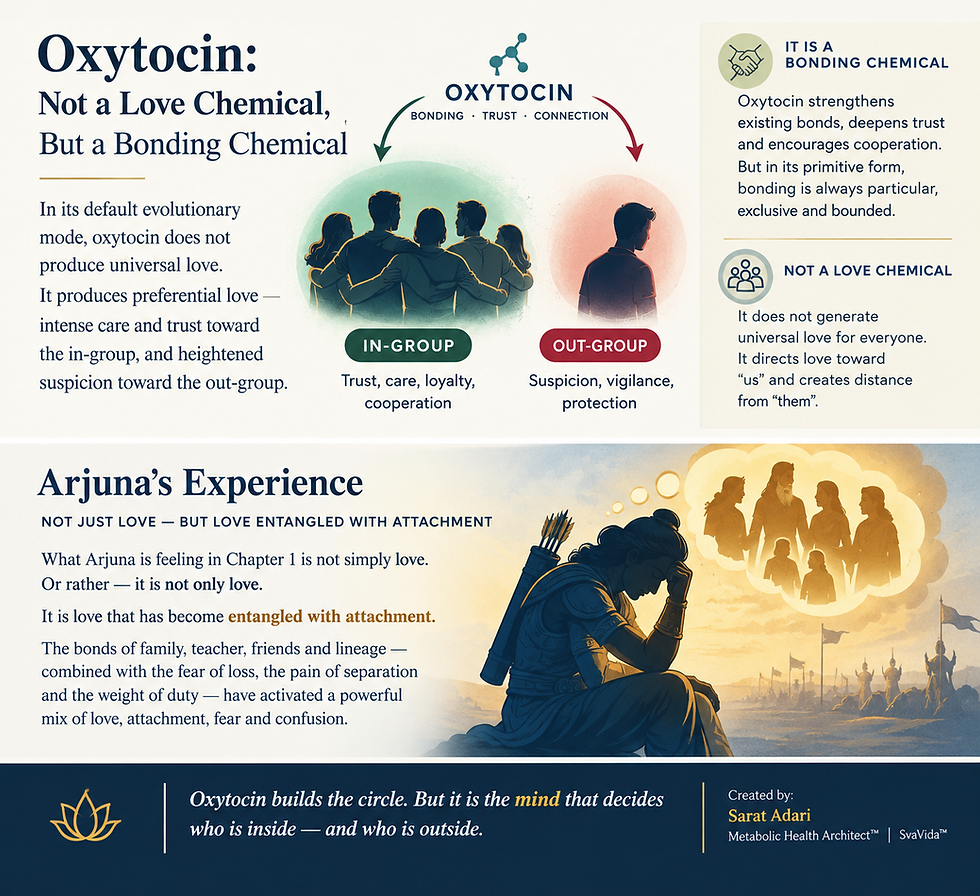
Throughout the text — Arjuna's entire crisis is fundamentally an oxytocin crisis. He looks across the battlefield and sees his grandsire Bhishma, his teacher Drona, his cousins, his kinsmen — the very people whose faces are coded in his oxytocin-bonding system as safe, beloved, irreplaceable. The thought of harming them collapses his will to fight. This is not cowardice — it is the oxytocin system doing exactly what it evolved to do: generating profound motivation to protect the in-group. Krishna's challenge is to help Arjuna widen the circle of his identity beyond in-group attachment — a move that requires shifting from oxytocin-driven tribalism toward a more expansive frame of dharmic duty.
Krishna's task in that moment is to loosen Arjuna's grip on this web of bonding — to help him act from dharmic duty rather than from tribal love.
But then, by Chapter 6, verses 29–32, the picture has completely reversed. The perfected yogi — the one Krishna is describing as the ideal — expands their sense of warmth and connection to encompass all beings equally. Not less connection. More. A limitless, boundary-dissolving love that sees the Self in every creature and every creature in the Self.
Contract here. Expand there. What gives?
Sarva-bhūtastham ātmānaṁ sarva-bhūtāni chātmani A true yogi observes Me in all beings and also sees every being in Me. He is a perfect yogi who, by comparison to his own self, sees the true equality of all beings, in both their happiness and distress.
This is the most neurochemically radical verse in the Gita. It describes the expansion of the oxytocin in-group from my people to all beings — dissolving the very in-group/out-group boundary that oxytocin normally enforces. This is not biology-denial; it is the transcendence of the tribal oxytocin response through a cognitive and contemplative reframe. The research on compassion meditation (loving-kindness practice) shows that precisely this expansion — extending the oxytocin-warmth response to strangers and even adversaries — is neurologically achievable and produces measurable changes in amygdala reactivity and insula activation.
It is the single most practically important teaching the Gita contains on the nature of human relationships. And modern neuroscience gives us the tools to finally see it with complete clarity.
First: What Is Oxytocin Actually Doing?
To understand why these two passages are not contradictory, we need to understand what oxytocin is — and crucially, what it is not.
Oxytocin is the neurochemical of social bonding. It is released during physical touch, during eye contact with someone we trust, during sex, during childbirth, during nursing, during moments of genuine emotional attunement. It creates the warm, safe, open feeling of being with someone — of belonging.
But here is what most people do not know about oxytocin. It is, by design, a tribal molecule.
In its default evolutionary mode, oxytocin does not produce universal love. It produces preferential love — love directed intensely toward the in-group and, simultaneously, heightened suspicion toward the out-group. This is not a flaw; it was a survival feature. Tight tribal bonds meant cooperative hunting, collective child-rearing, mutual defence. The oxytocin that made you fiercely protective of your clan members made you equally vigilant — sometimes hostile — toward strangers.
Paul Zak, one of the leading researchers on oxytocin, has called it the "moral molecule." But subsequent research has been more nuanced. Carsten De Dreu's work at the University of Amsterdam showed clearly that oxytocin promotes in-group favouritism and can amplify out-group derogation. It is not a love chemical. It is a bonding chemical — and bonding, in its primitive form, is always particular. Always exclusive. Always bounded.
This is the oxytocin system that Arjuna is running on in Chapter 1. His Pandava kinsmen are his in-group. His entire nervous system is screaming: protect them. Do not harm them. They are yours.
And that system — when fused with ego, with identity, with the terror of loss — produces his total neurological collapse.
The Critical Distinction the Gita Makes — and Modern Psychology Confirms
Here is the insight that resolves everything.
What Arjuna is experiencing in Chapter 1 is not love. Or rather — it is not only love. What it is, is love that has become entangled with attachment.
The Sanskrit word the Gita uses with surgical precision is moha. It is usually translated as "delusion" — but that translation flattens it. Moha is more precisely: the confusion of the self with the objects of attachment. It is the state in which you have wound your sense of identity so tightly around specific people, specific outcomes, specific relationships, that you can no longer tell where you end and they begin.
When moha is present, love is no longer free. It is fused with:
Dopaminergic craving — I need them. My sense of wellbeing depends on their presence.
Cortisol-driven loss aversion — Losing them is not just painful; it is existentially threatening.
Ego-construction — I am the son of Pandu, the student of Drona, the kinsman of the Kauravas. Remove those relationships and I do not know who I am.
This is what makes Arjuna's "love" so agonising and so paralysing. It is not the size of his heart that collapses him. It is the weight of his attachment. The oxytocin bonding has become entangled with craving, with fear, with identity — and when that compound structure is threatened, the entire nervous system goes into crisis.
The proof is in his physiology. He describes it precisely:
"My limbs fail and my mouth is parched, my body quivers and my hair stands on end. My bow slips from my hand, and my skin burns all over; I am unable to stand, and it seems to me that my mind is whirling." — Bhagavad Gita 1.29–30
Read that as a clinical description. Limbs failing — muscles becoming tense and motor control becoming less precise under an intense sympathetic surge. Dry mouth — sympathetic activation suppressing salivary secretion. Trembling — the effect of circulating catecholamines on skeletal muscle. Piloerection — sympathetic nervous system activation. Mind whirling — intense threat processing shifting the brain away from reflective, prefrontal control and towards rapid, emotionally driven responses.
Arjuna isn't describing an abstract emotion. He is describing a whole-body physiological state.
His fear/conflict isn't merely something happening “in his head”. His brain has perceived an overwhelming situation, and that perception has propagated through the autonomic nervous system, producing measurable changes in his muscles, salivation, motor control, hair follicles and cognition.
This is not what pure love looks like. This is what attachment in crisis looks like. This is what happens when the thing your identity depends upon is about to be taken away.
Krishna is not asking Arjuna to love less. He is asking him to disentangle love from need. To act from duty rather than from the terror of loss. To find a stable sense of self that does not depend on these particular people remaining exactly as they are.
What Attachment Theory Tells Us
Modern developmental psychology arrived at almost exactly the same conclusion — through a completely different route.
John Bowlby's attachment theory, and the decades of research that followed, identified three primary attachment styles, each with a distinct neurobiological signature:
Anxious attachment — the person whose early bonding experiences were inconsistent or unpredictable develops a nervous system that is hypervigilant about relationships. They bond intensely, but from a place of fear rather than security. They need constant reassurance. They experience their partner's or loved one's distress as existential. The loss — or even the threat of loss — of a bonded person produces catastrophic nervous system activation. They are, neurochemically, always in a mild version of Arjuna's battlefield state.
Avoidant attachment — the person who learned early that bonding led to pain or rejection develops the opposite strategy: minimal vulnerability, emotional distance, self-sufficiency as armour. They do not get close enough to be hurt. Their oxytocin system is not absent; it is suppressed. Walled off. They maintain the in-group net but keep it very small and very controlled.
Secure attachment — the person whose early bonding experiences were consistent, attuned, and safe develops a nervous system that can bond deeply without the terror of loss. They can be fully present in relationships, grieve losses without being destroyed by them, and — crucially — extend warmth and trust beyond their immediate circle. Their sense of self does not depend on any specific relationship holding together.
Notice what secure attachment produces. The same three things the Chapter 6 yogi demonstrates: deep bonding and equanimity in loss and expanded warmth toward others. Not because they love less. Because their sense of self is stable enough that love does not need to be possessive.
This is not coincidence. The Gita's developmental arc — from moha through nishkama karma (self-less or desireless action) to sama-darshana (equal vision) — is a map from insecure attachment to secure attachment, written in the language of consciousness rather than psychology. Two different vocabularies. The same journey.
The Neurochemical Arc — Precisely Mapped
Let me make this concrete, because the precision here is remarkable.
Stage 1: Arjuna in Chapter 1 — Moha
Neurochemical signature: Oxytocin bonded to dopaminergic craving + cortisol loss aversion + ego-constructed identity. The moment the attachment object is threatened, the entire compound structure destabilises. Prefrontal cortex goes offline. Catecholamines flood. Executive function collapses.
This is why the love feels so total and so unbearable simultaneously. It is not pure love — it is love with the full weight of the survival system riding on it.
Stage 2: Krishna's Prescription — Nishkama Karma
The instruction in Chapters 2 and 3 is not "stop loving." It is: disentangle the love from the craving. Act from duty, not from the terror of loss. Do your work; release your grip on the outcome. The dopaminergic craving — I need this specific result, I need these specific people to survive — is what Krishna is asking Arjuna to dissolve. Not the love. The need.
Neurochemically: reduce the cortisol-driven loss aversion by loosening the identity-fused attachment. Allow the prefrontal cortex to re-engage. Let the serotonin baseline stabilise — the equanimity that does not require external conditions to be a specific way.
Stage 3: Sthitaprajna — Steady Wisdom
The person of steady wisdom that Krishna describes in Chapter 2, verse 55 onwards — prajahāti yadā kāmān (when selfish desires are discarded) — has a serotonin-grounded baseline that no longer collapses with external conditions. They still feel. They still act. But the emotional floor does not give way when circumstances change. Such a person is described to be the one with 'Steady Wisdom'.
prajahāti yadā kāmān sarvān pārtha mano-gatān ātmany-evātmanā tuṣhṭaḥ sthita-prajñas tadochyate
Stage 4: The Chapter 6 Yogi — Sama-Darshana
Neurochemical signature: Oxytocin fully decoupled from ego-survival. No in-group/out-group boundary policed by the fear of loss, because there is no ego-constructed in-group left to protect. The same warmth that was once directed at specific people — hoarded, protected, defended — can now flow outward without boundary, because it is no longer serving the function of propping up an identity.
This is what the neuroscience of loving-kindness (metta) meditation confirms. Richard Davidson's research at the University of Wisconsin showed that long-term compassion practitioners — people who deliberately train the capacity to extend warmth toward strangers and even adversaries — show measurable changes in amygdala reactivity, insula activation, and default mode network function. The brain physically reorganises around a more expanded affiliative state.
And critically: these practitioners do not love their close relationships less. Their capacity for deep personal bonding is not diminished. What changes is that the love is no longer exclusive. No longer scarce. No longer defended.
Stage | Gita's Language | Psychological State | Neurochemical Signature |
Chapter 1 | Moha — delusion/attachment | Anxious/insecure attachment | Oxytocin + dopamine craving + cortisol loss aversion. Collapse when threatened. |
Chapters 2–3 | Nishkama Karma — desireless action | Beginning of secure base | Disentangling love from craving. Cortisol regulation. Prefrontal re-engagement. |
Chapter 2.55 | Sthitaprajna — steady wisdom | Earned secure attachment | Serotonin-grounded baseline. Equanimity without suppression. |
Chapter 6.29–32 | Sama-darshana — equal vision | Fully secure / post-egoic | Oxytocin decoupled from ego-survival. Boundless warmth without possessiveness. |
What Krishna Is Actually Removing — And What He Is Not
This is the line I want to state as clearly as I possibly can, because it is the most common misreading of the Gita's teaching on attachment:
What Krishna contracts in Chapter 1 is not love. It is the fear-driven possessiveness that has dressed itself up as love.
And what expands in Chapter 6 is what remains when that fear is removed: love in its unobstructed, undefended, unhoarded form.
Think about the most loving people you have known in your life. The ones who made you feel genuinely seen, genuinely safe, genuinely cared for. Were they people who clung to you? Who became destabilised when you were not available? Who needed you to be a certain way to maintain their own equilibrium?
Or were they people who were fully present with you, deeply warm, and yet somehow free — free enough to let you be exactly who you are, free enough to give without keeping score, free enough that their care did not feel like a weight you had to carry?
The second description is secure attachment. It is the Sthitaprajna in relationship. It is what the Gita is pointing toward — not the cold withdrawal of a recluse, but the warm, stable, unhurried presence of someone whose sense of self does not depend on you being any particular way.
That kind of love is expansive by nature. It does not need walls because it is not protecting anything. It does not need exclusivity because it is not scarce. It can extend to strangers and adversaries not because the person has suppressed their capacity for deep bonding, but because they have freed that capacity from the prison of ego-driven attachment.
The Practical Application — What This Actually Looks Like in Life
This is where I want to be honest, because I find that the most powerful ideas are also the ones most easily intellectualised without being lived. And this one demands to be lived.
Ask yourself honestly: who in your life do you love freely, and who do you love anxiously?
Freely loved relationships feel expansive. You want the best for them, including outcomes that might not involve you. You can be fully present when you are with them and genuinely at peace when you are not. Their struggles move you without destroying you. Their successes delight you without threatening you.
Anxiously loved relationships feel like a grip. You monitor them. You need them to respond in certain ways to feel okay. Their distance creates panic. Their choices feel like verdicts on your worth. You give, but there is a ledger running somewhere.
The Gita is not asking you to love the anxiously held people less. It is asking you to look clearly at what is happening in those relationships — and to recognise that what feels like love has a layer of moha underneath it. Attachment to an identity that requires the other person to stay, to behave, to affirm you.
And it is asking something quite radical: that the work of loosening that grip is not the work of caring less. It is the work of building a stable enough sense of self that the love no longer needs to be possessive to feel real.
Practically, this means:
Noticing when your emotional state is being completely governed by another person's behaviour. That is not love — that is dependency dressed as love. The neurochemical signature is dopaminergic craving fused with cortisol-driven loss aversion. You are, biologically, in a version of Arjuna's battlefield collapse every time they do not respond the way you need them to.
It means building your own serotonin floor — the internal sense of stability and worth that does not require external validation to remain intact. This is the work. Meditation, physical health, meaningful purpose, genuine community — these are not luxuries. They are the neurochemical infrastructure of a self that can love freely rather than anxiously.
And it means, over time, noticing that as the grip loosens — as the attachment disentangles from the craving — the love does not diminish. It clarifies. It becomes, in a way that is difficult to describe until you feel it, more real than it was before. Because it is no longer about you.
The One-Line Resolution
After everything above, let me give you the single sentence that contains it all:
The Gita does not ask Arjuna to love less. It asks him to love from a place that does not need love to survive.
Attachment is love in the grip of the ego's survival mechanism. What Krishna points Arjuna toward — and what the Chapter 6 yogi has arrived at — is love that has been freed from that grip. Not cold. Not distant. Not indifferent. Freed.
And freed love, by its very nature, expands. There is nothing left to protect it from.
A Final Reflection
I keep coming back to something that strikes me about Arjuna's crisis on the battlefield. Of all the warriors assembled that day — on both sides — Arjuna was arguably the most sensitive, the most moral, the most genuinely loving. His collapse was not a character flaw. It was his capacity for love running up against the ego structures it had become entangled with.
Krishna does not rebuke him for loving. He illuminates the difference between what Arjuna thinks is love and what love, in its liberated form, actually is.
That distinction — between moha and prema, between possessive attachment and free love, between the grip and the open hand — may be the most important thing any of us work on in this lifetime. Not in spite of our relationships, but through them. Every significant relationship we have is, if we look at it rightly, is exactly this.


Comments