


The Invisible Engine - Why David and Sarah’s "Healthy" Habits Aren't Working

Updated: Mar 24
If you're in your 30/40s, juggling work, kids, and life, you've probably said (or thought) something like this:
"My metabolism just slowed down after kids/turning 40—it's broken."
"I eat way less than I used to, but the weight keeps creeping on."
"I try to 'eat less and move more,' but the energy crashes and cravings win every time."
You're not imagining it. And you're not alone.
Meet David (43, tech sales dad) and Sarah (38, part-time remote mom managing the household chaos). They arrived at a recent Health Retreat feeling exactly like that—frustrated, tired, and convinced their metabolisms were permanently "damaged" from years of yo-yo dieting, stress, and inconsistent movement.
David and Sarah didn't come to our retreat because they were "lazy." They came because they were exhausted. The problem isn't their willpower. The problem is Governance. Their 200,000-year-old biological hardware is trying to run 2026 software, and the system is crashing.
The good news? Metabolism isn't broken or fixed in stone. It's dynamic, adaptable, and far more sophisticated than the old "calories in vs. calories out" equation we've all been sold.
In this first post of our Rebuilding Your Metabolism series, let's cut through the myths and get to what metabolism actually is—and how small, realistic changes can start shifting things for people just like David, Sarah, and you.
What Metabolism Really Is (Beyond the Bro-Science)
Metabolism is simply every chemical process in your body that keeps you alive. Breaking down food for energy (catabolism), building and repairing tissues (anabolism), regulating temperature, detoxing, making hormones, and more.
Think of it as your body's constant energy factory:
Catabolism burns fuel (carbs → glucose → ATP, fats/proteins broken down similarly) to release energy.
Anabolism uses that energy to build (muscle repair, hormone production, storing excess as glycogen or fat).
Your cells produce energy mostly as ATP inside mitochondria (the "powerhouses"). This happens 24/7, even when you're sleeping.

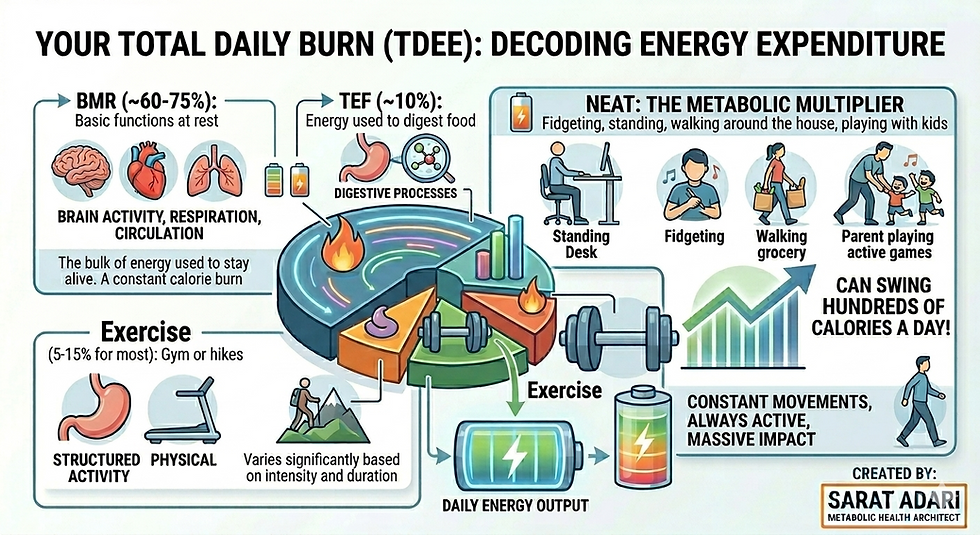
Your total daily burn (TDEE) comes from:
BMR (~60-75%): Basic functions at rest (heart beating, breathing, thinking).
TEF (~10%): Energy used to digest food (protein costs the most!).
Exercise (5-15% for most): Gym or hikes.
NEAT (the big variable): Fidgeting, standing, walking around the house, playing with kids—can swing hundreds of calories a day!
Metabolism is not a "speed"; it's a dual-process system of Building (Anabolism) and Breaking (Catabolism).
David’s Issue: He is stuck in Anabolic Dominance. His insulin levels are constantly "High," signaling his body to build fat tissue and never break it down.
Sarah’s Issue: She is in Stress-Induced Catabolism. Her high cortisol is breaking down her muscles and bone density to provide "emergency" sugar for a fight-or-flight response that never ends.
Evolutionary Premise: Why Our Metabolism Is Wired for Survival, Not Slimness
Our bodies aren't broken—they're brilliantly adapted... just to a world that no longer exists. For 99% of human history, energy (food) was scarce and movement was mandatory. Our bodies evolved to be Master Accumulators.
For most of human history (hundreds of thousands of years as hunter-gatherers), food wasn't available 24/7 at the tap of an app. Instead, life swung between feast (a successful hunt or abundant berries) and famine (days, weeks, or seasons without reliable calories). Starvation and food scarcity were among the strongest evolutionary pressures shaping our genome.
Enter the "thrifty" adaptations—often called the Thrifty Genotype idea, first proposed by geneticist James Neel in 1962. Genes and physiological traits that helped us:
Store excess energy efficiently as fat during rare abundance (quick insulin response, strong fat deposition).
Conserve energy fiercely during scarcity (lower metabolic rate, reduced NEAT/fidgeting, behavioral shifts toward rest and food-seeking).
Prioritize survival and reproduction (e.g., insulin resistance to redirect glucose to the brain, fat storage to buffer pregnancy and lactation).
These traits were lifesavers. A "thrifty" metabolism meant you could pack on fat quickly after a feast, then stretch those stores through lean times—boosting chances of surviving to reproduce. Famine was frequent enough that natural selection favored energy hoarders over big spenders.
Fast-forward to today: constant food access, minimal physical demands, chronic stress. The famine never comes. Those same thrifty mechanisms—once protective—now drive fat storage, insulin resistance, energy crashes, and metabolic slowdown when we eat in surplus or diet restrictively (your body "hears" restriction as famine and downregulates burn to protect you).

This is the evolutionary mismatch at the heart of modern metabolic struggles. David’s evening cravings and central weight gain? Echoes of an ancient system prepping for the next famine. Sarah’s fatigue, coldness, and stubborn midsection? A protective slowdown from a body that learned to conserve during scarcity.
Understanding this doesn't excuse the challenges—it empowers us. When we know why the system defaults to thriftiness, we can gently override it with consistent, nourishing inputs (protein timing, movement, recovery) that signal "safety and abundance" instead of threat. That's the foundation of real, lasting metabolic rebuilding—at the retreat and beyond.
(In the subsequent series we will look into: How this ancient wiring shows up in hunger signals...)
What's Next? Following David and Sarah Through the 4 Gates of Metabolism
Now that we've covered the fundamentals—what metabolism truly is and why our bodies are wired the way they are—it's time to get practical.
Your metabolism isn't a single "switch" or a mysterious black box. It's a sophisticated system with key checkpoints where things can go right... or get stuck. We call these the 4 Gates of Metabolism—a simple, powerful framework we'll use throughout this series to understand why energy feels off, weight stalls, or cravings take over for people like David and Sarah.
Think of food entering your body like cargo moving through a supply chain. Each "gate" processes, directs, stores, or burns that energy. When one gate is congested or underpowered (due to modern lifestyle mismatches, past dieting, stress, or age-related shifts), the whole flow suffers.
Here's the sequence we'll explore together:
Gate 1: The GI Tract (The Supply Chain) Where food is broken down, nutrients absorbed, and signals sent about what's coming in. Issues here (poor digestion, inflammation, microbiome imbalances) mean poor-quality "supply" reaches the rest of the system—leading to energy crashes, bloating, or nutrient shortfalls even when eating "healthy."
Gate 2: The Liver (The Administrative Office) The master regulator—decides what to do with incoming glucose, fats, and toxins: store, burn, convert, or detox. When overloaded (from constant high carbs, alcohol, stress, or fatty liver buildup), it favors fat storage and insulin resistance—exactly what David battles with his midsection and evening slumps.
Gate 3: The Muscle (The Energy Sink) Your largest metabolic organ and primary place to burn fuel (especially glucose and fats). More muscle + better insulin sensitivity here means higher daily burn and better energy partitioning. Sarah's fatigue and slow recovery point to muscle underutilization and adaptation from past restriction.
Gate 4: The Mitochondria (The Power Plant) The final destination—tiny factories inside every cell that turn nutrients into usable ATP. Mitochondrial health determines how efficiently you actually produce and use energy. When they're dysfunctional (from inflammation, nutrient gaps, or chronic stress), you feel "wired but tired" no matter what you eat or how much you move.

Over the coming weeks, we'll walk David and Sarah (and you) through each gate—one at a time—with real science, retreat-tested protocols, and actionable steps. You'll learn:
What goes wrong at each gate for common profiles (insulin resistance, fatty liver, perimenopause/thyroid slowdowns, PCOS, metabolic syndrome).
Signs to spot in yourself or others.
Gentle, effective ways to "open" the gates and restore flow.
By the end of the month, you'll have a full roadmap to rebuild metabolism from the inside out—not through restriction, but through nourishment, movement, and recovery that align with our ancient wiring in a modern world.
Ready to start feeling the shift? Follow this series to track your own energy patterns. And if you're craving hands-on transformation, spots for our next Health Retreat are filling fast—where we put these gates into action every day.
What gate do you suspect is holding you back most right now? Share in the comments—I'm here for the conversation.
📢 A Note on "Living Science"
Science is not a static destination; it is a moving target. While the principles discussed here are grounded in decades of metabolic research, new peer-reviewed data emerges every day, and I am committed to accuracy.
If you are a researcher, clinician, or dedicated student of physiology and you find a piece of data here that does not align with the latest high-quality evidence, please reach out. I welcome civil, evidence-based corrections. My goal is to keep this resource as the most accurate "No-Nonsense" guide to Metabolic Health on the internet. Let’s get better together.
*Disclaimer:
The information provided in this blog is for educational and informational purposes only and should not be construed as medical advice. While every effort is made to ensure accuracy, the content is not intended to replace professional medical consultation, diagnosis, or treatment. Always seek the guidance of a qualified healthcare provider with any questions regarding your health, medical conditions, or treatment options.
The author is not responsible for any health consequences that may result from following the information provided. Any lifestyle, dietary, or medical decisions should be made in consultation with a licensed medical professional.
If you have a medical emergency, please contact a healthcare provider or call emergency services immediately.

Comments