


What Isotope Tracers Reveal About Your Metabolism (And Why It Matters for Real People Like David & Sarah)

You've just learned how Gate 1 (your GI Tract) acts as the supply chain — breaking down food, absorbing nutrients, and deciding what actually reaches the rest of your body.
But once those nutrients cross into the portal vein and head toward the liver (Gate 2), what happens next? How does your body decide whether to burn them for energy, store them as fat or glycogen, build muscle, or send them somewhere else?
For decades, scientists have answered these exact questions using stable isotope tracers — a clever research technique that acts like invisible ink for metabolism. We now know that metabolism isn't a bucket; it’s a high-speed highway. Scientists use these "biological GPS tags" to track exactly:
How fast your tissues take in fuel.
Where "intermediate reactants" (the middle-men of your biochemistry) are getting stuck.
Whether your protein is actually building muscle or being diverted into waste.
Most people get their labs done once a year. They look at a number—say, a Fasting Glucose of 98 or Triglycerides of 140—and if it’s in the "normal" range, they assume the system is fine. In the world of Risk Management and IT Audit, looking at a single data point is useless. You don't audit a company by looking at their bank balance on one Tuesday in October; you audit the Transactions. You look at the Flow.
In metabolic science, we call this Flux. We look at the transactions in real-time (Flux). We use the science of tracer kinetics to understand how your body actually processes fuel, ensuring your 'Biological ROI' is maximized.
In this bridge article in our series, we'll break down what isotope tracers show us about real human metabolism, why it explains so many struggles in mid-life, and how we translate those findings into practical tools at Svavida™.
How Do Isotope Tracers Work? (The Simple Version)
Imagine giving your body a nutrient that looks and behaves exactly like normal glucose, fat, or protein — except it's been "tagged" with a slightly heavier, safe version of carbon, hydrogen, or nitrogen (stable isotopes).
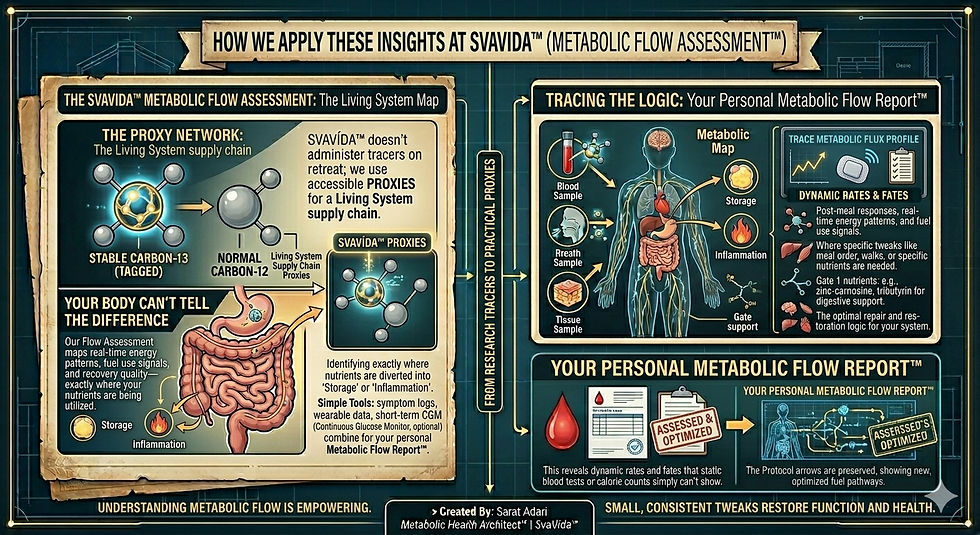
Your body can't tell the difference, so it processes the tagged molecule exactly as it would the normal one. Scientists then take blood, breath, or tissue samples over time and use advanced machines (like mass spectrometers) to follow where the tags end up and how fast they move.
This reveals dynamic rates and fates that static blood tests or calorie counts simply can't show:
How quickly proteins, triglycerides (fats), or glycogen (stored carbs) are built or broken down.
How fast different tissues (liver, muscle, fat) take up or release fuels.
Where intermediate molecules go — and whether they get burned for energy (oxidation) or stored.
Which fuel each organ prefers in different situations (fasted, after a meal, during stress, etc.).
In short: tracers give us a real-time map of metabolic flow — not just what’s in your blood, but how efficiently your body handles, partitions, and uses energy across the 4 Gates.

What Tracers Have Taught Us About Everyday Metabolism
The big takeaway? Metabolism is highly dynamic, tissue-specific, and adaptive — not a fixed "slow" or "fast" setting that declines irreversibly with age.
Tracers show that the same meal can be handled very differently depending on:
Gut barrier health (Gate 1) — poor digestion or high LPS leakage sends inflammatory signals that reroute fuel toward storage.
Liver regulation (Gate 2) — inflammation can impair insulin signalling before you’ve even fully absorbed the glucose.
Muscle capacity (Gate 3) — stronger muscle acts as a bigger "energy sink," pulling in glucose and fats for burning instead of letting them pile up as fat.
Mitochondrial efficiency (Gate 4) — how well cells actually convert nutrients into usable ATP.
This explains why David (with his insulin resistance signals) might store more of a carb-heavy lunch as belly fat and feel an afternoon crash, while Sarah (with her perimenopause/thyroid profile) might show slower overall fuel oxidation and recovery. Their bodies are partitioning energy differently — not because their metabolism is "broken," but because the flow through the gates has become congested by modern life, past dieting, stress, and inflammation.
We identify the traffic jams in your biochemistry. Tracers show us that when insulin is high, the 'exit ramp' for stored fat is physically locked. We don't tell you to 'eat less'; we unlock the gate so the fuel can actually reach the furnace.
Isotope tracers proved that different organs have different "fuel preferences". Using insights from tracer kinetics, we know your brain requires a specific 'Neurochemical Flux.' If your gut-to-liver transport is lagged, your brain's 'Dopamine Synthesis' is starved of precursors. We don't just help you to 'eat healthy'; we optimize the delivery route to the organ that needs it most.
The Evolutionary Premise (Why This System Exists)
Our ancient wiring plays a starring role here. For most of human history, food came in unpredictable feast-or-famine cycles, and infections or gut threats were common. The body evolved sophisticated mechanisms to:
Quickly store surplus energy during abundance.
Conserve and redirect fuel during scarcity or "sickness" (e.g., temporarily inducing insulin resistance so glucose goes to the brain and immune system instead of muscles).
Prioritize survival over constant high-energy output.
Tracers help us see these thrifty adaptations in action today. When Gate 1 leaks LPS or chronic stress keeps the alarm on, the system defaults to conservation and storage mode — exactly what feels like a "slow metabolism" for David and Sarah in our constant-food, high-stress world.
Understanding this mismatch is empowering. It means small, consistent inputs at each gate can gently shift flow back toward efficient burning and repair.

How We Apply These Insights at Svavida™
We can’t (and don’t need to) administer isotope tracers on retreat — they’re specialized research tools. Instead, we built the Svavida™ Metabolic Flow Assessment around accessible proxies that mirror what tracers measure: real-time energy patterns, post-meal responses, fuel use signals, and recovery quality.
Leveraging decades of Isotope Tracer research, Svavida™ maps your metabolic pathways as a living system. We don't just see a number on a page; we see a supply chain in motion. We identify exactly where your nutrients are being utilized—and where they are being diverted into 'Storage' or 'Inflammation'.
During your stay you’ll track:
Energy and clarity 1–3 hours after meals (proxy for tissue uptake and oxidation).
Hunger return timing and cravings (reflects substrate release and liver handling).
Recovery from gentle movement or walks (indicates muscle protein synthesis and sink capacity).
Digestion comfort and overall sustained energy (Gate 1 to Gate 4 flow).
We combine this with simple tools like symptom logs, labs, wearable data, and (for those who choose) short-term continuous glucose monitoring. The result is your personal Metabolic Flow Report — a clear map of where your gates need the most support and exactly which tweaks (meal order, Gate 1 nutrients like zinc-carnosine or tributyrin, post-meal walks, etc.) create the biggest shifts.
Guests often notice changes within days: steadier energy, fewer crashes, better recovery, and reduced cravings. That’s the power of applying tracer-level understanding through practical, felt experience.
What This Means for Gate 2 (The Liver)
As we move into the liver — your body’s administrative office that decides what to do with incoming nutrients — remember: cleaner supply from Gate 1 (less LPS, better absorption) means the liver can do its job more efficiently: regulating glucose, processing fats, and avoiding unnecessary inflammatory rerouting.
When the liver stays calm and effective, more fuel gets directed toward muscle burning (Gate 3) and mitochondrial energy production (Gate 4) instead of fat storage and inflammation.
Ready to Experience Better Metabolic Flow?
At Svavida™, we don't just "read" your labs. We audit your Metabolic Flux. If your triglycerides are high, We don't just see "fat in the blood." We see a Bottleneck in your fatty acid oxidation pathway. We see a "Gate 2" (Liver) that has lost its clearance authorization.
We stop asking "What is the number?" and start asking "Where is the fuel going?". When you understand the flux, you stop "dieting" and start Engineering.
If David and Sarah’s story sounds familiar, the next step is simple: give your body the right signals at each gate. Small changes in digestion support, meal timing, movement, and recovery can reroute how your body uses fuel — often faster than you expect.
If you’re ready for deeper transformation in a supportive environment, our next Health Retreat focuses on opening all 4 Gates with science-backed protocols and personalized flow mapping.
What’s one post-meal energy pattern you’ve noticed lately? Share in the comments — I read every one and it helps shape future posts.
To better flow and lasting energy,
Sarat Adari | Metabolic Health Architect™
📢 A Note on "Living Science"
Science is not a static destination; it is a moving target. While the principles discussed here are grounded in decades of metabolic research, new peer-reviewed data emerges every day, and I am committed to accuracy.
If you are a researcher, clinician, or dedicated student of physiology and you find a piece of data here that does not align with the latest high-quality evidence, please reach out. I welcome civil, evidence-based corrections. My goal is to keep this resource as the most accurate "No-Nonsense" guide to Metabolic Health on the internet. Let’s get better together.
*Disclaimer:
The information provided in this blog is for educational and informational purposes only and should not be construed as medical advice. While every effort is made to ensure accuracy, the content is not intended to replace professional medical consultation, diagnosis, or treatment. Always seek the guidance of a qualified healthcare provider with any questions regarding your health, medical conditions, or treatment options.
The author is not responsible for any health consequences that may result from following the information provided. Any lifestyle, dietary, or medical decisions should be made in consultation with a licensed medical professional.
If you have a medical emergency, please contact a healthcare provider or call emergency services immediately.


Comments